liki liki LED lighting design | show you have flair | Aliki Polydor

liki liki LED lighting design | show you have flair | Aliki Polydor
liki liki design | close to natural light

31 May 2008

liki liki LED lighting | ikra is for caviar
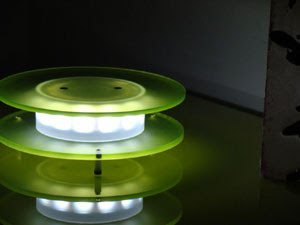
There is nothing like soft lighting to make a room precious and inviting for those late social events or for an intimate evening. And the most versatile, simple, and exquisite looking solution to achieve this beauty is "ikra" table lamp .

From our multifaceted approach to the lighting of space, we have experienced lighting as the single greatest determinant of how a space feels. The "ikra" is as precious as caviar! Its delicate tints will enlighten your bedside or reception tables and its soft romantic glow will trigger emotions and feeling. Color conveys information, and as a silent form of communication, it gets our message across powerfully. The passionate, strong, warm red grabs attention and advances. The refreshing, quiet, calming green soothes the mind for concentration. The welcoming orange creates that cheering and energetic atmosphere. The mystical purple enhances that sensual but dignified message.

Ambiance lighting comes in many sizes, shapes and types, but LED lights have advantages other lighting solutions do not have. The "ikra" can remain switched on all night long without any risks: no overheating, extremely low consumption and beautiful color rendering.

It is natural to place rigorous demands on the lamps that illuminate our surroundings. The eye prefers even lighting with a minimum contrast between the brightness of the room surfaces and the lighting fixtures. The "ikra" table lamp gives your room a sophisticated mix of real hues and authentic warmth. The result is a feeling of stepping into a cozy past, but with the benefits of illumination from the future.

19 May 2008

For wellness centers and spas : diode and perfume

patanjali®
designed by Aliki Polydor
is pure innovation in wellness and spas.

click here for the video or check it out!

You'll like it! liki liki made it for you.

18 May 2008

liki liki LED lighting design | luce pulita e bianca 2007

Con le lampade "zaff", "kissimu 3", "napo", noi ci crediamo!

Crediamo nell'importanza della customizzazione. Solo progetti su misura o piutosto a misura d'uomo e i suoi sensi.

design Aliki Polydor copyright 2007
Sempre con light emitting diodes, i famosi LED! Pensiamo al futuro. A questa luce pulita, decorativa che sorge di queste fonte luminose. Ma sopratutto che permette di creare suggestivi effetti ed ambienti.

09 May 2008

"napo" LED table lamp | liki liki LED lighting design | Casamica june 2008

Designing and making "napo" has also been great pleasure after Kissimu 3. I am very proud of it.

The "napo" table lamp will be seen in Casamica June 2008. As my previously designed lamps, it incorporates as always, the latest diode technology and avant-garde materials and it is soon to be produced in series.
It should normally remind you of one of the major figures in the history of France who has always fascinated my imagination.


Aliki Polydor 2008

08 May 2008

lampada kissimu 3 in Casamica maggio 2008

La questione è questa: scrivere su di un lavoro femminile da parte di un uomo corrisponde a quella che gli antichi latini chiamavano personata uox, ovverosia significa parlare attraverso la persona, che nel mondo antico corrispondeva alla maschera, che l’attore tragico o comico si metteva sul viso per interpretare una parte. Nel qual caso la parte è quella femminile; insomma ogni uomo che parla di un “fare” femminile parla sempre derrière le rideau, dietro un palcoscenico di cartapesta, e alla fine si tratta di accettarne le convenzioni.
Contrasto –non equivoco- che appare soprattutto in un caso quale il design, che parrebbe per certe sue geometriche complessita', a torto, sempre roccaforte maschile.

Per la lampada che si chiama “kissimu 3” , bisognerebbe tener presente innanzi tutto che si tratta di un oggetto creato da una donna, e dunque chi ne scrive è una personata uox, e inoltre è anche un oggetto d’arredamento, geometrico e sostanzialmente asimmetrico realizzato in più versioni le quali sono tutte prodotte in serie.

La lampada "kissimu 3" in questione poi possiede diverse “declinazioni”, “kissimu 1”, “kissimu 2", etc. insomma esistono delle “varianti”. Queste varianti sono date dalle possibilità che ha l’oggetto in questione di trasformarsi, di mutare (come molti altri oggetti dell’atelier di Aliki) a seconda dell’umore del suo proprietario, o fruitore. Lo si può manipolare (tema ricorrente) anche da parte di chi lo acquista, anche dopo essere stato realizzato. Insomma, è un “come tu mi vuoi” questa lampada che funziona sempre, come le altre dell’atelier, con un sistema illuminativo di “diodi”.

Sulla qualità della luce di queste lampadine a basso consumo mi verrebbe da spendere due parole: infatti è una luce che, a differenza di quella fredda del neon, non altera (beninteso che ogni luce non solare esegue una propria alterazione) il colori di quel che circonda, e benché all’apparenza fredda, non è mai “glaciale”. E poi si alimenta di una corrente a basso voltaggio; espediente che permette di ridurre il dispendio energetico, e poi probabilmente crea nella mente di chi sa questo, la non sgradevole sensazione che la lampadina non possieda la capacità di “fulminare”.

Oltre la digressione, questo tipo di lampada, nella sua sostanziale “informità” strutturale, sembra essere, oltre la sua funzione di “illuminatrice”, anche un oggetto. Il che significa ribaltare la “funzione” (la luce) in favore del “funzionante” (l’impalcatura, ovverossia l' "oggetto di design", che riveste la semplice lampadina).

Ruben Garbellini

29 April 2008

liki liki LED lighting design since 2006 | LEDs lights for the future

environmentally friendly: Switching to low energy, solid state lighting benefits the environment. LEDs consume far less energy than today's standard light bulbs, leading to greatly reduced energy costs. LEDs also require far less energy to manufacture than other light sources, reducing their environmental impact even further.

economy: Despite their initial high price, the use of LED lighting can offer significant cost savings over time, not only in terms of reduced energy consumption, but maintenance as well.

long life: Even in hostile conditions, the typical working life of an LED can be several tens of thousands of hours; most domestic bulb filaments expire after just a couple of thousand hours and even compact fluorescent lamps come nowhere near the working life of LEDs. Also, LEDs don't suddenly burn out - they slowly fade over time - giving ample opportunity to plan replacements - several years with normal use and possibly even decades. Even at the end of its working life, a LED will still be giving some light.

strength and reliability: The filament in an incandescent bulb is very fragile, easily broken by a sudden shock or "soft" drop. Fluorescent tubes are made of thin glass. A LED is encased in virtually unbreakable high strength optical grade resin. There is no glass or filament to break, making LED light sources perfect for rugged or demanding environments, or installations where access is difficult.

improved safety and security: The low heat and low voltages associated with LEDs make them a far safer source of light. No glass to break, no white-hot filament, no flames and no noxious fumes.

design flexibility: The intrinsically safe nature of LEDs, combined with their long term reliability and small size, make LEDs a lighting tool of unprecedented versatility.

luminous efficacy: Light emissions from LEDs are inherently directional, reducing the need for reflectors and diffusers that can trap light, so using LEDs can potentially deliver light more efficiently to the intended location.
Fluorescent and incandescent lamps emit light in all directions. Much of the light produced by the lamp is lost within the fixture, reabsorbed by the lamp, or escapes from the fixture in a direction that is not useful for the intended application. It is not uncommon for 40-50% of the total light output of the lamp to be lost.

dimming: When used in applications where dimming is required, LEDs do not change their color tint as the current passing through them is lowered, unlike incandescent lamps, which turn yellow.

UV emissions/infrared: LEDs produce no UV radiation and their light beam contains little heat, making them ideal for illuminating objects, such as works of art.

16 April 2008

liki liki design | latest diode technology for aromatherapy


Even though we have already introduced our "patanjali" table/floor lamp within the context of the home and public spaces, we are getting more and more requests about its implementation in luxury wellness centers and spas.

The "patanjali" with its ergonomical design and avant-garde conception can remain switched on for 24 hours a day without overheating. The three containers for the essential oils warm up to the right temperature of 40 degrees ideal for the diffusion of the same or different perfumes! Not to mention its extremely minimal power consumption which is characteristic of high technology LED lighting. Imagine no risk of overheating, watching, forgetting...

Its magenta colour further emphasises its value as an equally aesthetic object of design. Enjoy its refinement! For the senses are all there!

23 March 2008

kissimu 3 table lamp | liki liki LED lighting design

I don't know whether I wanted the "kissimu 3" table lamp to set up a mood, but I could certainly not imagine it without a soul! A structure potentially leading each and everyone of us to some sort of a far-fetched dream.

The "kissimu 3" goes beyond the "stability" intrinsically associated with the concept of a table lamp!
In a way it rather symbolizes a "taking off", referring to life's constant permutation and non-permanency.

The "kissimu 3" is at its best in contexts where space is reduced to its bare architectural limitations.
It is meant to provide breathing space, imaginary space but also intimate space.

Aliki Polydor 2008

09 March 2008

Ballarini Interni verona

Quick tour of our recent exhibition at Ballarini Interni, Verona on 27 February 2008. Many thanks to them for this possibility, and to all of you that attended this pleasant evening.


26 February 2008

liki liki LED lighting design | la lampada e il filosofo


clicca qui per il video


…la lampada "patanjali" , cui accennavo, è una specie di corpo diffusore in polyethylene, che si ispira a un filosofo indiano, per taluni vissuto sei o sette secoli prima di Cristo, per altri addirittura diecimila anni prima, una sorta di grande padre del pensiero yoga. La lampada si compone di un parte luminosa in metacrilato e in grado di emettere, a contatto col calore luminoso, profumi. L’idea è interessante, soprattutto se si vuol creare una sorta di atmosfera che leghi quest’oggetto, così “moderno” nelle linee, con il pensatore mitico cui è dedicata. Si tratta insomma di una dedica, con un evidente rimando all’idea di “illuminazione”, che forse ci converrebbe tradurre come coscienza: dunque una lampada-pensiero, termine bizzarro che mi viene or ora per definirla senza definirla lampada tout court, perché solo lampada non è. Ecco un’altra volta una combinazione, una amalgama, una cosa che diviene anche un’altra cosa. Si tratta di accendere questo oggetto/diffusore che ha al suo interno delle lampadine del futuro che sono i diodi, a basso consumo in capace di dar luce per moltissimo tempo, e di svitare uno dei coperchietti che contengono le tre essenze profumate di cui si vogliono, o singolarmente o mescolandoli, “ascoltare” gli odori per il "chez moi".

Ruben Garbellini

12 February 2008

liki liki LED lighting design studio | diodi e incipit

Aliki non rifiuta affatto questi ultimi cinquant’anni di ritrovati tecnologici. Pare quest’ultimo un discorso scontato ma così non è, perché per millenni si sono utilizzati legno, pietra, metallo al più e nei più fortuiti casi. Materiali quali le resine sintetiche, il plexiglas, l’alluminio, il silicone, la vetroresina, le plastiche, ormai talmente inglobate nella nostra vita da non essere più riconoscibili come parte “altra”, non sono affatto parte della nostra storia se non da meno di mezzo secolo. Per cui, considerare l’inevitabile amalgama (un’altra mutazione) che designers, architetti e artisti hanno saputo creare o dovuto subire non è affatto poca cosa. Tanto più che la velocità di frana che ha assunto la moderna “esistenza”, pure nei suoi differenti o quotidiani aspetti, non permette più antiche, pur tuttavia amatissime, disquisizioni sul bello e sulle sue categorie. China pericolosa, questa, che può allungarsi per non più ritornare.

Queste brevi note accennano perciò all’idea di “amalgama”, di quasi contaminazione, che sottende alcuni oggetti a circuiti stampati, diodi dello studio/laboratorio di Aliki Polydor. L’idea stessa di mutazione è presente in un luogo fisico, stesso laboratorio /studio, dove tanto si realizzano manualmente delle “cose”, tanto le si sottopone al giudizio e all’eventuale scelta del pubblico. Si tratta di un piccola catena produttiva che non viene spezzata, ma costituisce una quotidianità artigianale: un altro amalgama tra le materie tecnologiche più “nuove”come l'implementazione della tecnologia a LED e la concezione manuale dell’assemblaggio.Si chiama la "customizazione".

Ragionamento quest’ultimo che fa rimbalzare il pensiero verso il secondo polo, o aspetto, generatore degli “oggetti”(non definibili in altro modo, siano essi funzionali o più decorativi) di Aliki: il mondo della filosofia. Una cultura filosofica, nel caso di Aliki Polydor, anch’essa “mescolata”, che da un fulcro di τεκνή occidentale continua a rivolgersi verso la melancolia della dimensione metafisica dell’Oriente, sentita quasi come una meta necessaria da raggiungere. Nasce da questo la lampada-profumiera dedicata al leggendario filosofo indiano Patanjali?

2 febbraio 2008
Ruben Garbellini

31 January 2008

Organic light emitting diodes? the future?

...designing light means taking into account all the senses not just the visual...

Trends in lighting technology will probably involve further and considerable implication of design in studying and planning our environments.

Today space implies moods, and therefore "lighting" should remain central without imposing itself. If used wrongly and without adequate harmonization of elements, it can actually create opposite effects. This applies to both public and private space. A building which is heavily lit in a public area might provoke a sense of "anomy" or unwanted excitement. A home with inappropriate lighting might not offer the right soothing atmosphere longed for by its owners.

Light has strong repercussions on mood. We are talking about the five senses : all the senses interact to create a mood.

Designing "light" means taking into account "all the senses"- not just the visual - and obviously relying on technology and its progress. When designing light today we should look for authenticity and bear in mind the diversity and multiplicity in human expression. With light's "play" we are able to construct an environment which will cater for many moods and different situations. A lighting system can thus be contextualized depending on the commissioner's preferences, personality, goals and moods.

We are delving into a new language with the help of "light". Each lighting allows to express our "inner self" and its many identities.
Light and ambiance designers are here for that. Trust them.

Aliki

OLED- organic light emitting diodes-the lighting of the future?

liki liki design

Si apre la porta, si entra nel showroom-laboratorio well off di liki liki design. Il rumore e il traffico restano alle spalle, si resta catturati di una sensazione ovattata, i colori vivi e caldi ti avvolgono nella luce soffusa. Sono gli oggetti luminosi, piccoli e grandi, capaci anche di diffondere profumi, di emanare senti di spezie o essenze di fiori (diffusore luminoso ad alta tecnologia chiamato patanjali).
Luci e oggetti d'arredo o forse sculture luminose, in grado di cambiare la percezione di uno spazio, di un luogo. Forse anche di influire sul l'umore...

Camilla Bertoni, Verona 31 gennaio 2008

30 January 2008

liki liki design | olfactory design | "patanjali"| light and aromatherapy Ecohitech Award

moods and scents?

A scent reflects a mood and a mood prescribes a scent.
Should people stick to the same particular scent and always use it for a specific mood?
Everything is perception – olfactory components which are often ignored contribute to finding our way in an environment or a given architecture.
In our society, the senses are perceived in a dissociated form: often, the olfactory is separated from the visual; but isn't it more gratifying when these senses operate all together, in a subtle alchemy?
Try thinking about it.
It is looking intensely into the hidden quality of things…such as the LED technology that helps provide quality, precision and functionality.

About This Blog

Not simply skimming superficially through the subject of LED lighting.

Not just designing light but explaining it.

Rare these days !

LED News

LEDs Products

   original template by Ourblogtemplates.com 2008

Back to TOP